Category Archives: Blogging

Smorgasbord Posts from Your Archives – When I Am Not Enough…by Tina Frisco

SALLY CRONIN consistently offers free promotional opportunities on her blog. I recently contributed four articles to her series, Posts from Your Archives.  If you would like to join in, Sally gives directions at the end of each post.
Sharing thoughts and feelings with so many lovely bloggers was a  wonderful experience. Today I’m sharing the fourth and final article I contributed. Find the first three here: 
Problem, Lesson or Opportunity?
Rejection: The Ultimate Teacher
What Is Success?
I’m grateful to Sally for her abiding generosity and for inviting me to participate ❤
*************  Sally Cronin

Welcome to the series where you can share four of your links from your archives here on my blog to a new audience. Perhaps posts that you wrote at the beginning of your blogging experience that deserve another showcase. If you have book promotion posts then please contact me separately for other options. Details of how to get in touch with me at the end of the post.

In the last in Tina Frisco’s series of four posts, she takes us through the process of how we can be our own worst enemies when it comes to putting ourselves down. We all know how negative words can be harmful when used to communicate with others but when we turn them inwards we can do long-term damage to our own belief in who we are.

When I Am Not Enough…by Tina Frisco

Image courtesy of Lucie Stastkova

Throughout our lives, we hear ourselves say:  ‘I’m not that good!’  ‘I’ll never make it.’  ‘I wish I could write that well.’  ‘If only I had said. . .’

Words are powerful. Energy follows thought. The words we speak to ourselves drive our subconscious minds. Diminishing thoughts tell the subconscious we are not enough.

The subconscious mind is self-serving. Its mission is to fulfill our every desire, and it sets in motion the means by which to do so. It takes our words at face value and strives to manifest what they represent. It assumes that what we think and say is what we hope and dream.

How often have we heard ourselves utter, ‘Did I say that’? Unless we are channeling spirit, the mouth speaks what the subconscious mind thinks. If thought rests in the conscious mind, we are aware of it and can choose whether or not to give it a voice. If thought rests in the subconscious mind, we might find ourselves surprised by our own words.

Negative off-hand remarks might seem benign, but they are potent energy viruses that infect the subconscious mind through repetition; repetition which, over time, becomes emphatic. The virulence of this self-denial is potentiated by the subterranean stream of thought that mirrors the spoken word and continues feeding the subconscious. The subconscious then compels us to speak what it believes to be our truth.

This might seem like a vicious cycle that can’t be broken; yet anything is possible, because nothing is set in stone. Even dense matter can be converted to energy.

The way out is the way in.

If we wish to realize our full potential, we need to become witness to ourselves. We must remain alert to and aware of all we manifest in word and deed. And we must do this without judgment.

Labels proclaim. Proclamation reinforces. Reinforcement cements. Cement imprisons.

Your mind is a powerful thing. When you filter it with positive thoughts, your life will start to change. –Buddha

Image courtesy of Lucie Stastkova

In order to build who we wish to be, we first need to become the unbiased observer and witness all we say and do. Notice the patterns. Write them down. Pay attention to the frequency in time and space, i.e., how often we repeat and how much mind space we give these cemented beliefs. This process enlightens us to the being we think we are. It moves the subconscious into the realm of the conscious. Once we become aware of our self-talk, we can make change for the better.

Continue reading … 

Source: Smorgasbord Posts from Your Archives – When I Am Not Enough…by Tina Frisco | Smorgasbord – Variety is the spice of life

Smorgasbord Posts from Your Archives – What is Success? by Tina Frisco

Along with other fellow bloggers, I’ve been contributing articles to SALLY CRONIN‘s series, Posts from Your Archives. This is my third, and you can read the first and second HERE and HERE. If you would like to join in, Sally gives directions at the end of each post. My thanks to Sally for inviting me to participate and for her ongoing  promotional support ♥  

Sally Cronin

Welcome to the series where you can share four of your links from your archives here on my blog to a new audience. Perhaps posts that you wrote at the beginning of your blogging experience that deserve another showcase. If you have book promotion posts then please contact me separately for other options. Details of how to get in touch with me at the end of the post.

This week Tina Frisco explores our perceptions of Success. Something, as with Happiness we strive to find. The path to success is not all plain sailing and there is a very good reason for that…. discover more in the post.

What is Success by Tina Frisco

Image courtesy of Lucie Stastkova

While writing the introduction to a fellow author’s book, I realized many of us view success as an end-product. We aspire, we strive and, if fortunate, we manifest. Only then do we feel gratified, overlooking all we accomplished in the process. In short, we fail ourselves.

If we become discouraged when met by an obstacle, we are not seeing that obstacle for what it truly is: a teacher. Obstacles not only teach us what does not work, but they also challenge us to reach beyond our perceived limitations. Obstacles are opportunities to practice what we have learned, alter our approach, and move forward. This is success.

Being stuck in obsessive thought patterns, limiting beliefs, or anything that stops us short of reaching a goal can lead to wallowing in the past (nostalgia) and yearning for the future (desire). Turning inward and finding the embedded thoughts sabotaging our efforts keeps us in the present and increases our chances of manifesting our dreams. This is success.

When we look within, we establish a willingness to explore our dark side and discover who we truly are. Throwing caution to the wind and delving into the depths of our psyches allows negative beliefs to surface and be recognized. We then can alter our approach by trying something new. This is success.

An experiential (versus therapeutic) approach to learning offers the highest chance of success, because learning is achieved through experience. Experience involves braving the unknown. The unknown holds all potential for advancement. If we do not commit to success by staying in the present, we could very well achieve bitterness and defeat.

Acknowledging each effective step we take toward realizing our dream is a marked success. In so doing, we achieve much more than the goal itself; we claim each and every one of our efforts as worthy of recognition.

Continue reading … 

Source: Smorgasbord Posts from Your Archives – What is Success? by Tina Frisco | Smorgasbord – Variety is the spice of life

Polldaddy URL on Blog Comments

Have you ever felt as if you were being shadowed? I recently felt this way when a strange url began appearing next to comments I’d made on several blogs I’d visited.

Terri Webster Schrandt
Image Courtesy of Terri Webster Schrandt

I thought my computer had contracted malware, a virus, or worse. But a lovely Happiness Engineer at WP told me it was a link for visitors to rate either comments or blog posts. The url is associated with Polldaddy, a service of WP’s parent company, Automattic.

And the culprit is:

https://polldaddy.com/js/rating/rating.js

If this url is appearing next to comments on your blog, it’s because your Ratings feature is activated. There are two ways to disable it. Go to your WP admin panel and (1) click Settings > Ratings > Comments, or (2) click Feedback > Ratings > Settings. Then uncheck the box next to ‘Show Ratings on’ Comments.

If you already have this feature disabled on your blog, but the url shows on comments you’ve made on others’ blogs, it’s because they haven’t disabled it. The link will not appear next to comments on your blog.

Happy blogging! ❤

Smorgasbord – Posts from Your Archives – Rejection: the Ultimate Teacher by Tina Frisco | Smorgasbord – Variety is the spice of life

Sally Cronin has graciously invited her followers to share four posts from their archives. This is my second one in the series; you can read the first one HERE. Directions on how to participate are given at the end of each post. Thank you to Sally for the abiding generosity and support she offers our community ♥ 
*************

Welcome to the series where you can share four of your links from your archives here on my blog to a new audience. Perhaps posts that you wrote at the beginning of your blogging experience that deserve another showcase. If you have book promotion posts then please contact me separately for other options. Details of how to get in touch with me at the end of the post.

Today Tina Frisco puts a different spin on rejection. It is rare for anyone to go through their lives without some form of this hurtful action from others. Tina however looks at this as an opportunity to grow and evolve as a person.

Rejection: the Ultimate Teacher by Tina Frisco

Countess Lucie Stastkova
Image Courtsy of Lucie Stastkova

Rejection comes in many forms, from many places, and is very painful. What makes rejection so devastating? What causes us to react in a particular way? How can we use rejection to our advantage?

On a purely instinctual level, rejection threatens to extinguish our life force by depriving us of vital nourishment. No being can truly thrive without some measure of love and acceptance.

Rejection devastates when we attach our personal worth to someone or something outside of ourselves. Feeling worthy only when liked and accepted by those with whom we engage sets the stage for rejection.

When feeling disliked or ignored by another, it is wise to step back and view that person’s behavior as a mirror of our own subconscious mind. Often the things we do not like in ourselves are reflected back to us by others, giving us an opportunity to examine what prompts us to react and how we might change. This not only buffers the impact, but also opens the door to personal growth. Becoming the witness rather than the victim allows us to determine if our behavior rather than our essence is being rejected, or if the other person’s bias is in play, and/or if we simply are misreading all the cues.

Behavior learned throughout childhood is largely determined within the context of the example set by the adults in our lives. When we incarnate, we become blank slates to be imprinted upon by everyone and everything around us. We react to external stimuli positively or negatively, based on whether our basic needs are met or neglected. As we mature, we learn we have choices. Those choices include how we feel and whether we react to or act on those feelings.

The key to using rejection to our advantage lies in remaining objective. However, behaving as an unattached witness can be difficult when our impulse is either to strike or withdraw. If we recognize impulse as being instinctual – a reflex action rather than a thought process – then we are taking a first step toward understanding our feelings and turning rejection into a positive learning experience.

When observing animals in the wild, it becomes clear that instinct is, in part, a survival mechanism. Although we humans do not live in the wild, we find it impossible at times not to react. Generally speaking, however, our survival does not depend on ‘fight or flee.’ Most often we have the advantage of time and space within which to consider our options and teach ourselves to behave differently. We are capable of changing our behavior and, quite possibly, our feelings. With a little practice, we can move ourselves to the threshold of choice: act or react. Success in achieving this pivots on focusing our intention.

Change occurs in three stages: (1) we witness our behavior after we have reacted; (2) we take note while we are reacting; (3) we stop ourselves before we react. When we reach the final stage, our behavior reflects choice (act on) rather than reflex (react to). Since most change occurs over time, perseverance becomes vital to success. Yet once we are rooted in firm resolve, observing ourselves can be fascinating.

Continue reading . . . 


Source: Smorgasbord – Posts from Your Archives – Rejection: the Ultimate Teacher by Tina Frisco | Smorgasbord – Variety is the spice of life

Posts from Your Archives – Problem, Lesson or Opportunity by Tina Frisco

Sally Cronin is graciously hosting me and other authors on her blog series, Posts from Your Archives. Sally is multi-talented and administers a blog that exemplifies her character: Smorgasbord Invitation. If you’re not familiar with Sally, do yourself a favor and rectify that! Her blog is highly #recommended

Return and Reviews

I’m happy to return from my blogging break and report that my mother has recovered and is progressing well. My heartfelt thank you to those who kept in touch with emails and messages. Love is the backbone of existence, and I’m so grateful for its presence in my life.

I’m still in catch-up mode, so it will take me a few days to get back in sync with visiting your lovely blogs and dealing with my social network pages. The nearly 700 emails that greeted me have slowed me down a bit 🙂

Although I had no time to be online and visit blogs during my break, I did read and review several books while traveling cross-country by train. I found all of them delightful, compelling, and enlightening. I can’t think of a better way to re-enter the blogging world than by featuring the following reviews.

************************* 

YELLOW HAIR by Andrew Joyce  Yellow Hair by Andrew Joyce

My 5-Star Review
A Native Truth Unveiled

In this gripping historical novel, Andrew Joyce threads the fictitious tale of a White man’s life-changing events through the factual tapestry of the devastation suffered by the Plains Indians at the hands of the American government. The White man is Jacob Ariesen, who becomes known as Hin Zi or Yellow Hair.

It is Spring of 1850 in North America. Imagine you are a member of a wagon train of one hundred and forty-four White people going West in search of a better life. You encounter overwhelming hardship and are rescued by Indians. You are treated well and with respect.

Now imagine you are a Plains Indian. Soldiers invade your land at the behest of their government. They do not ask your permission. They do not treat you with respect. They look upon your people as savages and presume all you hold dear is theirs for the taking. They force you to sign their treaties, by which they trick you into selling acre after acre of your land in exchange for gold. You tell them you have no use of the yellow metal, but they deceive you into trusting you can use it to barter for horses, tools, food, and other necessities. They employ deception time and again when their Congress rewrites the treaties – without your knowledge or consent – and drastically cuts the agreed-to purchase price. They literally steal your land, upon which soldiers build forts and settlers build houses. The Wasichus (Whites) trap and hunt indigenous wildlife into near extinction, forcing you to become dependent on the American government for your very existence. You once were proud, fierce, and free. You now are demoralized, displaced, and angry.

In this sober and eye-opening tale, Joyce strips away the facade of righteousness brandished by White military and political figures, people whose names appear dominant in American history. He lays bare the greed and fear that fueled their ignorant beliefs and heinous deeds, not the least of which was the bloody slaughter and mutilation of women, children, and old ones.

Noted Native American figures, presented as one-dimensional savage people in White history books, become fully developed animated characters under the pen of Andrew Joyce. They jump off the page, grab and captivate the reader. Among these are Sitting Bull and Crazy Horse, who pull us into their world and show us first-hand the effects of severe hardship coupled with dehumanization.

This was the perfect book to read while traveling across the United States by train and following the Colorado River for 230-plus miles. I imagined covered wagons caught in deadly currents that drowned all life forms as they carried them downriver. I imagined the battle at Wounded Knee Creek. I imagined the Battle of the Little Bighorn fought on the banks of the river that lent its name to this historical event. But most of all, as the train moved through mountain gorges and territories not traversed by automobile or person, I imagined a time when life was lived by the seasons, close to Mother Earth. My heart broke as distant memories of such a life played across my mind like a slide show.

This book is a page-turner that kept me glued from beginning to end. It is very well-written and chock-full of engaging characters, be they honorable or deplorable. I appreciated the humor Joyce attributed to the Indians, which he sprinkled throughout the novel. This added an inherent humanizing dimension to the indigenous peoples of whom Americans learn so little in school.

I also appreciated that the author intermittently but consistently focused on Native American spiritual beliefs. My favorite line was: “It is a good day to die.” In what way is that spiritual? you ask. Well… You’ll just have to read the book and figure it out for yourself. Hoka hey!

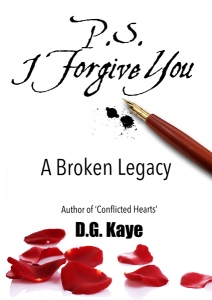
P.S. I FORGIVE YOU by D.G. Kaye P.S. I Forgive You by D.G. Kaye
My 5-Star Review
A Courageous Revealing

Parenthood does not come with a user manual. Children learn parenting skills from the adults in their lives. They generally emulate what they see and experience. If their lifelong experience is a negative one, they might be inclined to perpetuate it. But this does not have to be so.

In her compelling memoir, P.S. I Forgive You, D.G. Kaye reveals the habitual neglect and abuse she and her siblings suffered at the hands of an envious, threatening, narcissistic, and deceitful mother.

It takes courage, strength, and determination to prevail over hardship, especially when it is a constant in childhood; especially when a parent perpetrates neglect and abuse. But it is not impossible to overcome adversity when one focuses their intention.

Kaye shows us how to take the energy consumed by feeling mistreated, hurt, fearful, and guilty, and instead make it work for us by directing that energy toward building self-esteem, fortitude, and positive intention. She tells us how she reacted as a child, and then shows us how, as an adult, she turned a negative into a positive. Acceptance, compassion, and forgiveness are major players in this scenario, a dynamic that tested the author’s resilience, challenged her conscience, and ultimately allowed her to triumph over the all-consuming adverse conditioning perpetrated by her demanding narcissistic mother.

I highly recommend this book to anyone whose childhood was hijacked by a neglectful and abusive parent, and who would like to learn how to break free and live a happy healthy life.

SAM: A SHAGGY DOG STORY by Sally Cronin
My 5-Star Review
Do You Speak Dog?
Sally Cronin

Sam: A Shaggy Dog Story is one of the most delightful books I have ever read. Sally Cronin gives her Rough Collie a voice, allowing him to narrate his own tale.

A few of the things Sam tells us about are his friends (cat, dog, and human alike), his favorite things (sausages, cheese, ice cream, snow), his job as security consultant, car rides while singing along with Sally, and walks along the beach.

Sam is very observant and intelligent. He learns to understand both cat and human vocal sounds. He also learns to speak a few human words! Mawgh is more; heyoo is hello; and Orh, Ee, Va is Oliver. ‘More’ and ‘Oliver’ are interchangeable, as they both indicate he would like ‘mawgh’ of a delicious treat he had just enjoyed.

Sam’s introduction to cats is very positive. When he is still a puppy, Sally and her husband David – the alpha humans in Sam’s pack – adopt a feral cat whom they dub ‘Henry.’ Henry teaches Sam many worthy things about life, and they become great friends. Also, a feral mama cat has kittens on Sam’s property, and he dubs himself their guardian. These experiences prepare Sam for when Sally brings home two kittens. He readily steps up to the plate, nurturing and protecting them.

Sam’s story is heartwarming and humorous, sure to amuse and delight adults as well as children. I read this book in one sitting and was disappointed when it ended. I wanted more, and so will you.

What I appreciated most about Sam’s story is that it leaves the reader with a heightened respect for nonhuman animals. They think and feel as we do; and anyone who thinks otherwise will be hard-pressed to hold on to that opinion after meeting Sam. I would like to see this book offered for sale through animal rights and humane organizations around the world. And for me, that is the highest praise…

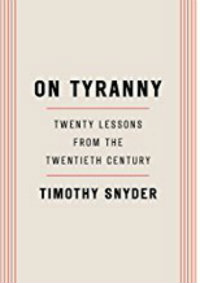
ON TRYANNY by Timothy Snyder 
My 5-Star Review
“It can’t happen here.”

In his eye-opening book, On Tyranny, Timothy Snyder draws parallels between Nazism/Fascism/Communism and what is occurring now in the United States of America. It is a small book, quickly read but packed with relevant data.

The road to tyranny can be subtle, drawing people in with false or exaggerated claims of terrorism from homeland or abroad. Real news is purported to be fake and is consistently repeated as such, gradually moving people to mistake falsehoods for truth. Free thinkers become the enemy of the State, and the exercise of free speech becomes a criminal act.

The author suggests that truth dies in four modes: (1) open hostility to verifiable reality; (2) endless repetition that makes the fictional plausible and the criminal desirable; (3) open embrace of contradiction; (4) misplaced faith. Snyder states we have witnessed all of these with the current U.S. President. (1) During the 2016 campaign, the candidate vehemently repeated lies as facts; 78% of his factual claims were found to be false. (2) Repeating “Build that wall” and “Lock her up” served to reinforce the connection between him and his followers rather than describe what he actually planned to do. (3) He promised to cut taxes and erase the national debt while also promising to increase defense spending. These promises were mutually contradictory and encouraged people to abandon reason. (4) “I alone can solve it” was a self-deifying claim that made truth “oracular rather than factual” and made “evidence” irrelevant.

Snyder details the progression to tyranny in Nazi Germany, Fascist Italy, and Communist Russia, showing how small and often subtle changes serve to lure the people, little by little, into accepting the dogma of tyranny and, thus, tyranny itself. He warns us to be wary of one-party States, paramilitaries, and dangerous language.

Entrancing words can mesmerize and entice people into blindly accepting the prelude to tyranny. Once the prelude is established, totalitarianism slides into place with ease. It would behoove those of us living in democratic countries to remain vigilant to this slippery process. Tyranny is a beast with many tentacles. We need to recognize them and prevent their institution. We need to dialogue with each other and realize that differing opinions are healthy and necessary to democracy. We need to pinch ourselves daily and remain alert to subtle changes that would erode democracy (e.g., The Patriot Act trades freedom for a false sense of safety). We need to get involved in the democratic process and not fall prey to the mistaken belief: “It can’t happen here.”

Tyranny can gain a foothold anywhere people are drawn in by a charismatic leader whom they follow blindly. In remaining alert, aware, and vigilant, we are our own best allies.

************************* 

Thank you for reading my reviews, and I’ll see you soon on your lovely blogs. The beautiful featured image is courtesy of Terri Webster Schrandt ❤

Blogging Break

My life is on hold right now. My mother is ill, and I’m preparing for a cross-country trip to visit with her. Over the past several days, most of my time has been consumed by back-and-forth phone calls with my sister.

I have had little time to visit all of your lovely blogs, comment, and share your posts. I will be offline for the most part over the next two months.

My mother is eighty-seven years old. I pray she lives to see her eighty-eighth birthday on Christmas Eve, Christmas being her favorite holiday.

Wishing everyone a wonderful Summer’s end and Autumn’s beginning. Be well, my friends, and remember to keep your hearts open. Namaste ❤

(Featured image is courtesy of Terri Webster Schrandt)

#ShiningLight Annette Rochelle Aben

Annette Rochelle AbenAnnette Rochelle Aben is a shining light in the world. I’ve had the pleasure of several conversations with her, and the most striking thing I’ve learned is that she walks her talk. Her Angel Messages, Inspirations, and Attitude of Gratitude posts are spoken from her heart. She is the real deal. 

If you’re not familiar with Annette and her work, you will find her HERE and HERE. Listen to her Blog TalkRadio shows for an infusion of support and enthusiasm as The Magic Happens. 

This week on her blog, Annette posted two public messages: an apology to herself and a letter to her ex-husband. Both embody understanding, compassion, acceptance, and forgiveness. It is with a grateful heart that I share them with you now.

A Public Apology to Myself

A Public Apology to Myself

A Public Letter to My ExHusband

A Public Letter to My ExHusband

#Author/BloggerSpotlight D.G. Kaye aka Debby Gies

While I was on break preparing my first novel for republication, I missed several wonderful posts by my lovely friend Debby Gies.  Debby is one of the most supportive authors it is my privilege to know. She writes compelling memoirs and has five outstanding books to her name. Find them HERE.

Debby’s latest memoir, P.S. I Forgive You, was published in October 2016 and has received nothing less than 5-star reviews.

P.S. I Forgive You by D.G. Kaye

Aside from sharing the work of fellow authors, Debby also writes thought-provoking articles and regularly shares helpful tips.  I’d like to share a few of these now. Perhaps you missed them as well. Since I’m still in catch-up mode,  I’m including a few of her later posts.

I hope you enjoy these as much as I have ❤

#Kindness Rocks Project – #WATWB – How it Began – How to Participate

The Story of My Life – Writing Prompts – Memoir- 10 Things that Sparked Childhood Creativity

The Other Inconspicuous Form of Bullying – Emotional Bullying

Aging and Wisdom – The New Perennial Age of Women

Just Sayin’ – Get Your Best Deals When Purchasing Apps and Website Services

Sunday Book Review – The Fountain – Short Stories by John Maberry

SPOTLIGHT: D. G. Kaye ~ Live. Laugh. Love. And Don’t Forget to Breathe. | The Writer Next Door

In Between Friday Shares with Tina Frisco and Sally Cronin

Just Sayin’ – How to be Resourceful – Seeking Resolution with Postal Issues


Want to know what’s happening at the #BloggersBash? Here’s the Agenda.

Ali Isaac has posted the long-awaited agenda for the 2017 Bloggers Bash. Hugs on, shoes off, get ready to party! Wishing everyone a fabulous time  🙂